Avatar Palace Museum · faces, rooms & software

Some rooms
stay with you.

A screen name. A favourite game. The friends on the other side of the room. Come back for a look—or discover the places and little faces people remember.

Palace Chat · artwork by Nino

Some faces
you keep.

The collection’s owner credits Nino with making a rainbow of glossy smileys for Palace Chat, and kept them as a personal favourite.

That is a later chapter of Palace. The classic Palace32 faces have their own story below.

A favourite worth keeping.

Artist and intended client are identified by the collection’s owner. The original artwork date is unconfirmed.

Keep this story in your collection →

A walk through the software

Same rooms.
New windows.

The client is the program you open to visit a Palace. Each chapter brought different ways to make a face your own, carry your favourite props, and find people in the rooms.

A few stops in an overlapping history. Dates describe the evidence we have; they do not mark a single chain of replacements.

  1. 1994–1995Prototype to public release

    The Palace

    Pick a spot. Say hello.

    Jim Bumgardner began Palace at Time Warner Interactive in 1994, with early room art by Damon Williams. People could share an illustrated place, with little faces showing where they were.

    That office experiment reached a public beta in September–October 1995 and an official release that November. The idea already had room for play: the 1994 proposal pictured smileys gathered around card tables.

    Jim Bumgardner’s account ↗
    Colourful smileys gathered around two green card tables in the original Palace proposal illustration.
    Before the first public roomsJim Bumgardner · concept illustration · July 1994Displayed with permissionFrom Jim Bumgardner’s history collection ↗
  2. February 2000Version 3.5 readme

    Palace 3.5 / Palace32

    Your face. Your prop bag.
    Your corner of the room.

    The classic Windows client kept rooms, expressions, props, and sounds close at hand. Version 3.5’s notes describe better MIDI playback and fixes for prop editing and private whispers—the small things that help a room feel alive.

    Remember “Palace35” and “Palace32”? Our saved 3.5 installer contains a program named Palace32.exe. Those names belong together in this chapter.

  3. 2002–2008Surviving development records

    Phalanx

    Bring your prop bag along.

    Trying another client could mean bringing favourite things with you. Brainhouse Laboratories’ Phalanx included an import tool for Palace prop bags; its 2005 update also added conversion of saved avatars, bookmarks, and media.

    There was more to make, too. The client’s change log records 32-bit props and smileys in May 2004, alongside work on image editing, sound, and rooms. This preserved editor artwork shows the tools for working on those little pieces of identity.

    Inside the Phalanx archive ↓
  4. 2008–2011Archived clients & documentation

    Palace Chat

    A tab for every Palace.

    Palace Chat’s guide describes keeping several Palaces open in tabs, trading avatars, and saving favourite looks. Its toolbar put the room list, sounds, drawing tools, and prop bag within reach.

    Jameson Heesen, known as PaVVn, created the client. Saved copies of versions 3 and 4 carry 2008 file dates; ElitePalaces dates its acquisition to 2010. Nino’s smileys belong to this story too: artwork the collection’s owner loved enough to keep.

  5. TodayChecked September 2026

    The story keeps going.

    Newer clients still invite people to collect props, build rooms, and spend time together. These current project sites describe their own software and the people continuing the work.

    pchat.org

    PalaceChat v5

    Avatars, room creation, painting, and video are part of today’s feature list. The site credits Jameson Heesen as creator, ElitePalaces as owner, and Alexandra as version 5’s maintainer.

    Explore PalaceChat v5 ↗

    thepalace.app

    The Palace

    The Palace Restoration Project offers a client for Windows, macOS, and Linux, with prop editing, animation, and games among its room experiences.

    Explore The Palace project ↗

    The exact version history and code relationship between these projects remain open in our collection notes.

The people are part of the history

A favourite room is only half the story.

The other half is who you found there. There is space here for old memories, new visitors, and the details we have yet to recover.

Classic Windows client

The classic
Palace32 faces.

A grin, a wink, a very surprised look. The Palace32 face picker brought expressions and colour swatches together in one tiny panel.

Two preserved images match resources inside the Palace32 program in our version 3.5 installer. Its readme is dated February 2000. The individual artist and original artwork date remain unconfirmed.

Small enough to remember.

The face picker measures 88 × 110 pixels; a single smiley measures 44 × 44 pixels.

Read the source trail →

Keep this story in your collection →

Avatar Palace · room history

So many places
from one doorway.

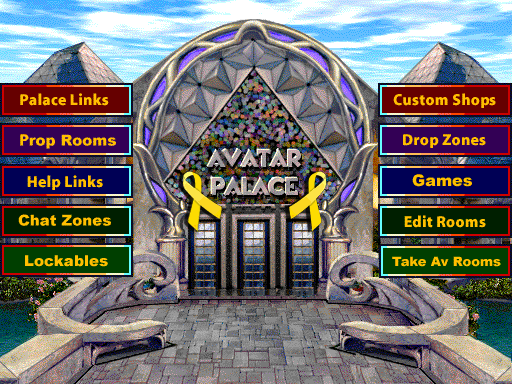
Prop Rooms. Chat Zones. Games. Take Av Rooms. The classic gate made the room itself a map of places to go. A favourite game, a familiar name, a place you knew how to find.

A copy of its background survives in the Avatar Palace Time Machine collection. Its creator and original date are not established in the accompanying record.

Where did you go first?

Room names and remembered routes are part of the story, too.

Share a memory →

Keep this story in your collection →

A foundation, not a finished archive

The record is still taking shape.

This first public selection combines a permissioned concept illustration with stories drawn from the surviving records. Other historical images are not included in this release while display details are reviewed. A recovered file is evidence of a surviving copy, not proof of its original author, date, or reuse rights. Original artwork, recovered material, and reconstructions should each be named for what they are.

This is an independent Avatar Palace collection. No museum affiliation or endorsement is implied. Rights remain with their respective holders.

Sources for the software story

Names and dates come from the surviving packages, the people who made the software, and the projects’ own sites. Package timestamps describe the copy we have; they do not establish a first release.

  1. The beginning. Jim Bumgardner’s 2002 account of Palace’s development describes the 1994 prototype and 1995 beta and official release. His history collection dates the proposal illustration to July 1994. It is concept artwork, not a screenshot.
  2. Classic Windows. The saved palace35.zip contains PalaceUserWin.exe. Its bundled README.TXT identifies version 3.5 and is dated February 2000; its PALACE32.EXE reports version 3.5.0.211. The two catalogued GIFs match the program’s embedded FACEDIB and FACEPICT resources byte for byte. The separate Palace32-win-400 folder contains build 3.5.0.194, so its folder name does not establish version 4.0. A bundled tutorial screenshot survives; its capture date is unstated. Checksums establish the extracted files’ integrity, not an independently authenticated publisher signature or the artwork’s first appearance.
  3. Phalanx. The phalanx_readme.txt inside Phalanx4Full.exe credits Brainhouse Laboratories and includes dated entries from 20 August 2002 through 18 April 2007; the initial-release entry is undated. Version 3.3.0.0 PR3, dated 24 May 2004, records 32-bit prop and smiley support. The Import Wizard readme documents prop conversion from 2003 and adds macro, bookmark, and media conversion on 1 June 2005, with updates through September 2008. The preserved prop-editor skin comes from the preserved PhalanxBetaUpdate5.7.50.exe. A full screenshot of a running client remains a gap in this exhibit.
  4. Palace Chat. The saved Mac packages identify versions 3.0.47 and 4.0.06 and creator Jameson Heesen; their entries carry October and December 2008 timestamps respectively. Those are archive dates, not first release dates. The basics guide, last edited 27 February 2011, describes tabs, avatar exchange, and the toolbar. Its interface image record dates the upload to 23 September 2010 by Psycrow; it does not establish the capture date or exact client version. The project documentation identifies Heesen as PaVVn. ElitePalaces’ own history dates its acquisition to 2010.
  5. Present-day projects. PalaceChat v5 supplies its own credits. The Palace identifies The Palace Restoration Project, and its client page lists Windows, macOS, and Linux. Checked 11 September 2026. This timeline does not claim a verified code lineage between these projects.
  6. Nino’s artwork. The collection’s owner identified Nino as the artist, Palace Chat as the intended client, and the sheet as a personal favourite on 11 September 2026. The surviving copy was found at resources/app/img/smileys.png in an archived Palace client folder. Its artwork date is unconfirmed.